
What Australian Restaurants Need to Know About the New Seafood Labelling Requirements
If you run a restaurant, café, takeaway or other hospitality business in Australia and serve seafood, there is an important menu update you need to know about.
From 1 July 2026, new mandatory seafood country of origin labelling requirements apply to hospitality businesses across Australia.
Restaurants now need to clearly identify whether the seafood served in a dish is:
A – Australian
I – Imported
M – Mixed origin
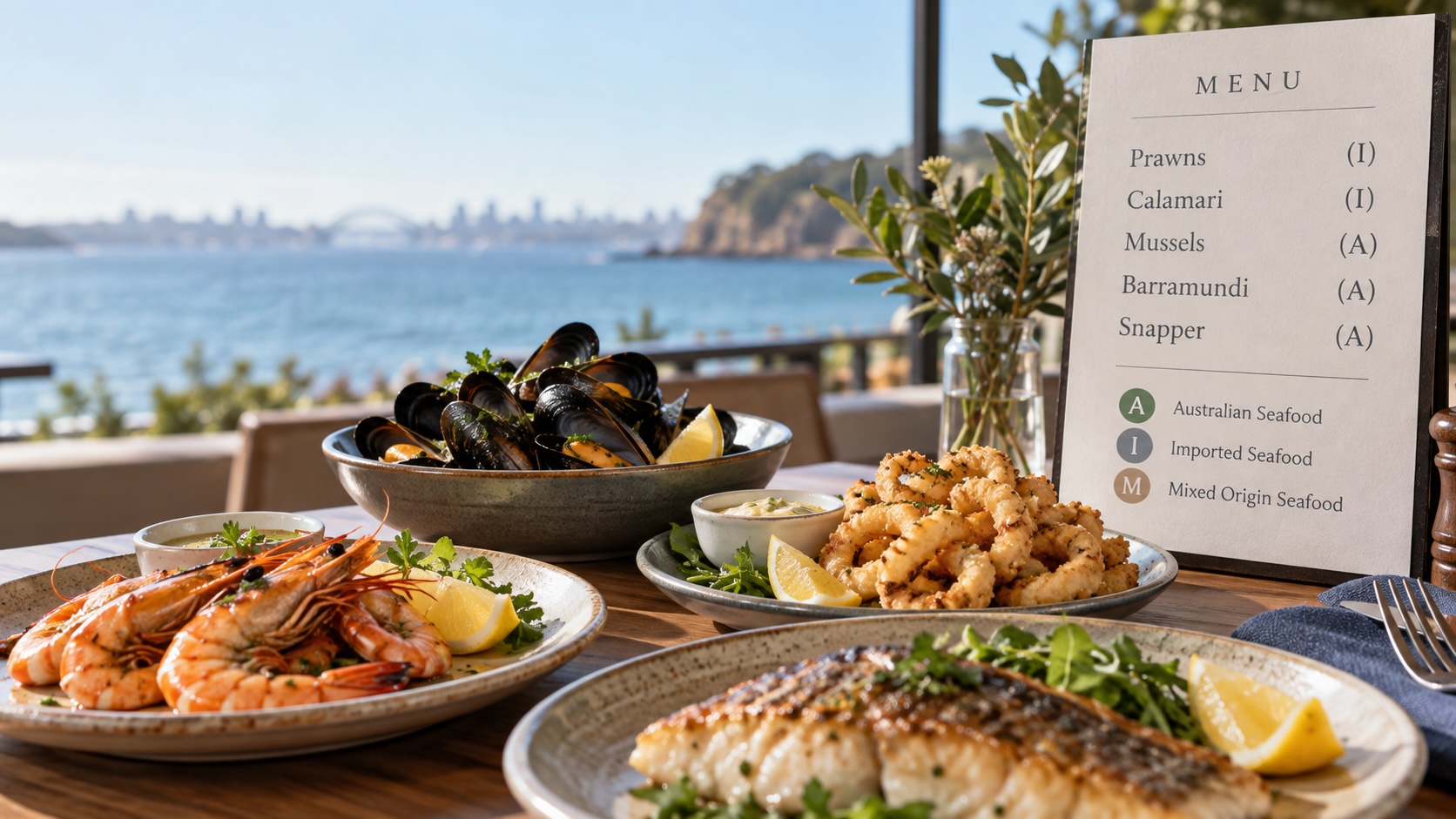
For many restaurants, this means adding an (I) beside menu items containing imported seafood and making sure the same information appears across printed menus, digital menus and online ordering systems.
What Are the New Seafood Labelling Requirements in Australia?
The new requirements are part of Australia’s country of origin labelling rules for seafood sold for immediate consumption.
They apply to hospitality businesses such as restaurants, cafés, pubs, clubs, takeaway businesses and food trucks.
The system uses a simple AIM model:
A = Australian
The seafood was harvested in Australia.
I = Imported
The seafood was harvested outside Australia.
M = Mixed origin
The dish contains both Australian and imported seafood.
The purpose is to make it easier for customers to understand where the seafood they are ordering comes from.
What Does (I) Mean on a Restaurant Menu?
The letter (I) means the seafood is imported.
For example:
Garlic Prawns (I)
Salt & Pepper Squid (I)
Soft Shell Crab (I)
New Zealand Mussels (I)
If your restaurant uses the A, I and M abbreviation system, you also need to provide a clear legend explaining the letters.
For example:
(A) Australian | (I) Imported | (M) Mixed origin
The legend needs to be clear and easy for customers to understand before they order.
What Does (M) Mean?
The M label means a dish contains seafood from both Australian and imported sources.
For example, a seafood stir-fry might contain Australian prawns but imported squid.
You could label the dish:
Seafood Stir-Fry (M)
Alternatively, restaurants can provide more detail:
Seafood Stir-Fry – Prawns (A), Squid (I)
This gives customers more specific information about each seafood ingredient.
Which Seafood Dishes Need Labelling?
The requirements can apply to many common seafood ingredients found on Australian restaurant menus, including:
- prawns and shrimp
- fish
- squid
- octopus
- crab and lobster
- oysters
- mussels
- scallops
- clams
- roe and other seafood.
The requirement can also apply when seafood is an ingredient in a dish that is marketed as containing seafood.
For example:
Prawn Pad Thai (I)
Seafood Tom Yum (M)
Salt & Pepper Squid (I)
Grilled Barramundi (A)
A dish does not necessarily need to have the word “seafood” in its name for the rule to apply. A dish commonly understood to contain seafood may still need country of origin labelling.
Do Fish Sauce, Oyster Sauce and Shrimp Paste Need an (I) Label?
Not every ingredient made from seafood requires an AIM label.
Some seafood products are excluded from the requirements.
For example, certain liquid, powdered and shelf-stable seafood products may be exempt, including products such as fish stock, shrimp paste and canned tuna.
So a stir-fry containing oyster sauce does not automatically require an (I) simply because oyster sauce is used.
However, if the dish is marketed as containing prawns, squid, fish or another covered seafood ingredient, the origin of that seafood may need to be displayed.
Does the Rule Apply to Takeaway and Online Ordering?
Yes.
The seafood labelling requirements aren’t limited to customers dining inside your restaurant.
They apply to seafood supplied for immediate consumption, including:
Dine-in
Takeaway
Delivery
Online ordering
The important point is that customers need to be able to see the seafood origin information before they place their order.
That means restaurant owners should check more than just their printed menus.
You should also review your:
- website menu
- online ordering system
- QR ordering menu
- digital menu
- menu boards
- takeaway menu
- delivery ordering pages.
If you use an online ordering system for your restaurant, make sure the A, I or M information is also added to the relevant menu item names or descriptions.
Don’t Forget Your Restaurant Website
Your restaurant website is often one of the first places customers look at your menu.
If your website contains seafood dishes, check that the country of origin information is accurate and clearly visible.
For example, instead of:
Chilli Prawns
your menu might now display:
Chilli Prawns (I)
Or:
Chilli Prawns – Imported
Restaurants using ZAAP ORDER can also review their website and online ordering menus to make sure customers see consistent information across each platform.
If your current website is difficult to update, you can also learn more about ZAAP ORDER restaurant website design
What If All Your Seafood Is Imported?
There is another option for businesses that use only imported seafood.
Rather than adding (I) beside every seafood item, eligible businesses can use a clear statement explaining that all seafood served by the business is imported.
For example:
All seafood served by our restaurant is imported.
Likewise, a restaurant using only Australian seafood can display an appropriate statement explaining that all seafood is Australian.
However, this option isn’t suitable if your restaurant uses a combination of Australian and imported seafood.
How Do You Know Where Your Seafood Comes From?
Restaurant owners shouldn’t guess the origin of seafood.
Check the information supplied by your seafood supplier.
Country of origin information may appear on:
- invoices
- receipts
- product packaging
- supplier documentation
- written supplier statements.
If the origin isn’t clear, ask your supplier to provide the information in writing.
Businesses also need to keep evidence supporting the seafood origin information for three months after they stop selling the relevant product.
What Happens If Your Seafood Supplier Changes?
This is something restaurants should pay particular attention to.
For example, your regular supplier might normally provide Australian squid.
Your menu could show:
Salt & Pepper Squid (A)
But if that product becomes unavailable and your supplier temporarily replaces it with imported squid, your menu may need to change to:
Salt & Pepper Squid (I)
This is why seafood country of origin labelling shouldn’t be treated as a one-time menu update.
Restaurants should check the information whenever suppliers or seafood products change.
Remember to Update Your Digital Menu Too
Updating a printed menu is only one part of the job.
Your seafood labels should remain consistent wherever customers can view or order food.
If your restaurant uses a POS, QR menu, website and online ordering platform, check each one.
A useful workflow is:
1. Check your seafood supplier information
Confirm whether each seafood item is Australian, imported or mixed.
2. Update your master menu
Add the correct A, I or M labels.
3. Update your website
Make sure your online menu matches.
4. Update online ordering
Check takeaway, delivery and QR ordering menus.
5. Update printed material
Review dine-in menus, takeaway menus, menu boards and promotional material.
6. Recheck when suppliers change
Make seafood origin part of your regular menu-management process.
Updating Your Restaurant Menu With ZAAP ORDER
Managing menus across multiple platforms can become complicated, especially when restaurant information needs to change quickly.
ZAAP ORDER provides digital solutions for restaurants including restaurant websites, online ordering, POS systems and digital menu services.
Our restaurant online ordering system allows restaurants to manage online orders through their own website, while our website design services can help businesses keep their restaurant information and menus easy for customers to access.
If you’re already a ZAAP ORDER customer and need help updating seafood information on your website or online menu, contact the ZAAP ORDER team.
If you’re looking for a new restaurant website, online ordering system, POS or digital menu solution, you can get started with ZAAP ORDER.
Restaurant Seafood Labelling Checklist
Before you finish updating your menu, check:
✓ Which dishes contain seafood
✓ Where each seafood ingredient was harvested
✓ Whether each item should be A, I or M
✓ Your AIM legend is included if you’re using abbreviations
✓ Your printed restaurant menu is updated
✓ Your website menu is updated
✓ Your online ordering menu is updated
✓ QR and digital menus are updated
✓ Your supplier records support the information shown
✓ Your seafood labels are reviewed when suppliers change
Final Thoughts
Australia’s new seafood labelling requirements are a relatively simple change, but restaurants need to make sure the information is accurate everywhere customers see their menu.
The biggest thing to remember is:
A = Australian
I = Imported
M = Mixed origin
And if your menu changes, your website and online ordering menu should change too.
Keeping your printed and digital menus consistent not only helps you meet the new seafood labelling requirements, it also gives customers clearer information before they order.
For the latest requirements and official guidance, always refer to the Australian Government’s seafood country of origin labelling information.
Need help?
Get started with ZAAP Order <Click here>